
How to Draw #2
First Steps

This writing assumes you have read the previous writing concerning the primacy of the page. With that firmly in mind we may proceed to an initial approach to the problem of drawing. This approach is embodied in a set of rules or guidelines. These are not rules of drawing as such, but should be understood as structuring this initial approach. The approach is proposed in the context of learning via the internet, or learning from these writings with, it is hoped, help from me or more advanced students who can see photos of your work. Were it possible to teach in person the procedure would be different, and more adapted to the individual student.
Following these rules, trying to respect these guidelines or parameters, or working towards the greatest fulfilment of them you can manage at each attempt, will develop awareness of, and mastery over, the most basic elements of drawing. These basic elements concern, first of all, the page and then the subject. Most fundamentally they concern the relation of the subject to the page. This is not usually thought of as the essence of drawing. That essence is usually, and incorrectly, thought to be representation of the subject.
The page is flat. You will be making marks and lines on a page. This is the “decorative” aspect. Your lines will decorate the surface of the page. The subject, however, has volume. Expressing the subject means expressing volume; this is the “illustrative” aspect. Each line you draw is “decorative”: it is a line on a flat piece of paper. Each line you draw is also and simultaneously “illustrative”. Whether you intend it or not, whether the effect is weak or strong, each line will have spatial implication. One way or another, and in relation to the page and other marks, each mark will have a relation of nearness and farness in the context of the page. Every mark is therefore always both decorative and illustrative. Eventually this should always be at the front of your mind, though initially that may not be fully possible. It is something to work towards but need not be a major concern at the beginning.
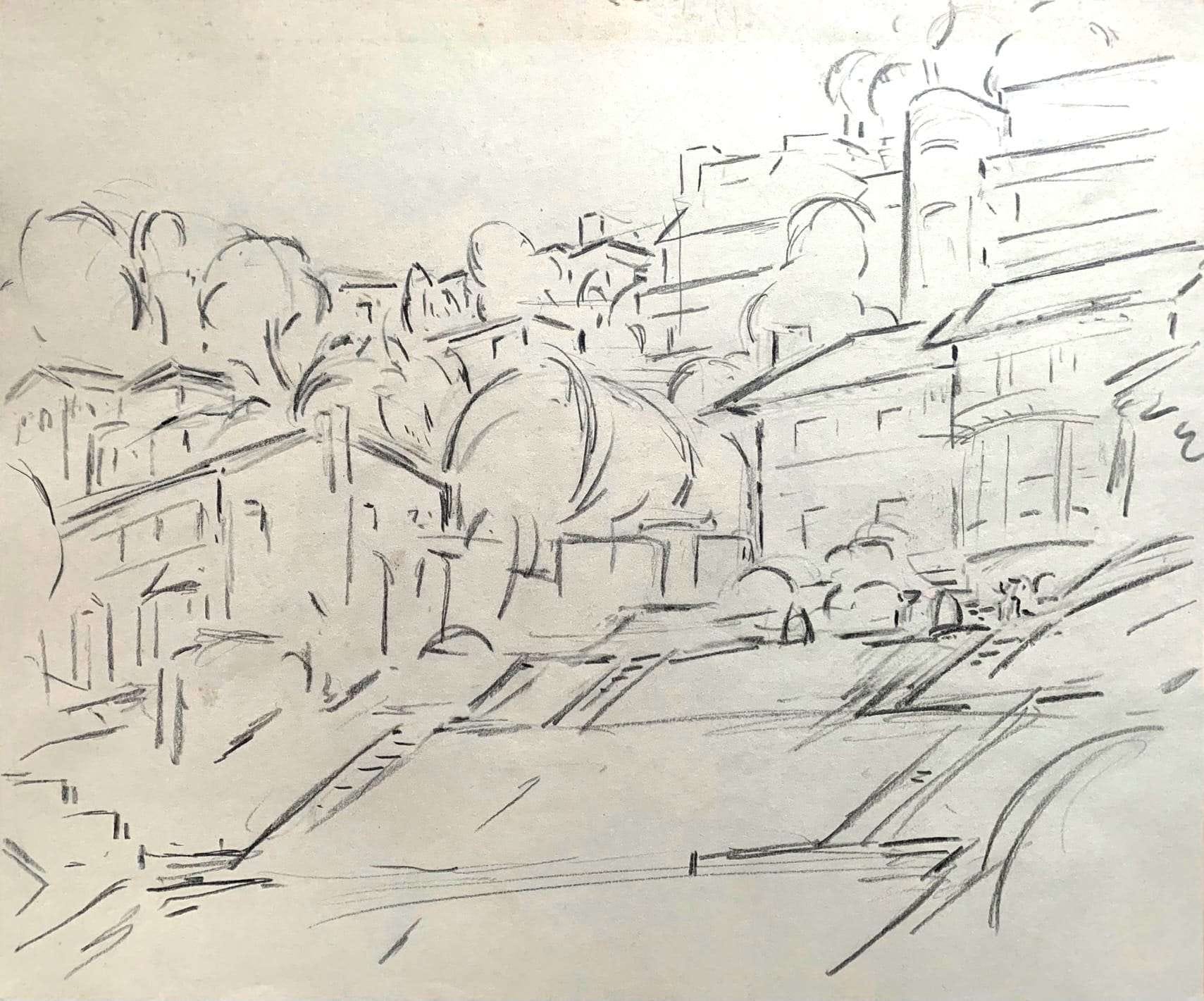
Drawing is “decoration” of a piece of paper, made of marks, principally lines. For the purposes of our approach please limit the type of marks used to lines which are clearly made, whether long, short, broken or dot-like. Avoid smudging, scumbling or anything vague. I do not mean to suggest that ways of marking the page other than clear lines are illegitimate but that, for the purposes of initial training, you should try to restrict yourself to clearly placed lines, and habituate yourself to doing so. Furthermore, you should not consider drawings you make in the context of this approach as expressions of your personal creativity. Think of them like a trip to the gym. Rather than strengthening your body, you are strengthening your mind’s capacity to cope with the problem of drawing and your hand’s capacity to fulfil your intentions.
Drawing requires a deft hand but, however deft the hand, it does not guide itself. When the drawing mind is undeveloped the hand tends to try to make up for the mind’s inadequacy. Our approach is arranged to help overcome the formation of the catastrophic habit of allowing the hand to try to do the thinking upon which drawing depends. The hand cannot think; it should be a docile and ready servant of the mind.
DO NOT JUDGE
If in the process of learning to be a plumber you failed to tighten a joint properly, you might be disappointed but that disappointment probably would not interfere with your fundamental ‘amour-propre’. You would probably feel that, being now made aware of the problem, you would know to tighten the next joint properly. That would probably be the extent of the psychological aspect of the matter. After all, plumbing is only a job. It would be best, however, if you thought of this initial approach to drawing as something like learning the art of plumbing or carpentry: the garnering of know-how for effecting a certain kind of work. In other words do not think of it as the making of art. It would even be wise to banish forever from your heart the idea that the making of art is a test of your soul.
Even if plumbing is a less noble activity than drawing, a man’s personality is revealed just as much in the work of plumbing as in drawing. Drawing ultimately offers more scope for personal expression, but there are certainly works of the plumber’s art which, to true connoisseurs, are far more satisfying and expressive of a man’s personality than an infinity of poor drawings. Do not, therefore, judge your own work, except, eventually, as it relates to the parameters of this initial approach. At the beginning, however, you are probably not yet fit even for that. Rely on more advanced students for judgement and guidance. Restrict yourself to the struggle of respecting the guidelines.
Furthermore, you should not concern yourself with beauty, personal expression or anything you may consider artistic or poetic. Such things arise naturally out of understanding and mastery of the principles embodied in our approach. They will take care of themselves. You need not think about them now and, as I hope you will learn, you will never need to concern yourself with them at all! They are an inevitable function of your true intentions (which may not be what you think they are) and your mastery of the art of drawing.
Ideally, after initial training with plaster casts of heads, hands and such, training in drawing would proceed with live models. In our situation of virtual learning and teaching, these steps are usually not possible. The ideal subject for drawing training is the human body; the nude. Models, nude models in particular, may not be available to you. In that case choose subjects which are as much like a nude model as possible: a clothed person, posing or not, an animal, a statue. Other possibilities are a chair, a tree, plants or objects of various kinds. Whatever subject you choose, define it as your subject, and respect the rules of the approach with regard to “subject”.
The first and most important rule is:
1 - MAKE THE SUBJECT FILL THE PAGE
This means that the subject should be as large in the page as possible (leaving reasonable margins!) while respecting the proportions of the subject. Additionally, the subject should be well centered. The whole subject must be included, particularly the lower part. When working independently you might choose as your subject a part of a model, or choose to place a subject in an eccentric place in the page. For the purposes of this approach the subject must be a complete thing, whether person, animal, plant or object, and it must fill the page and be as centered as possible.
Assuming your page is rectangular, the first determination to make is whether to orient the page vertically or horizontally. If the subject is wider than it is high, a reclining model for example, then the page should be oriented horizontally.
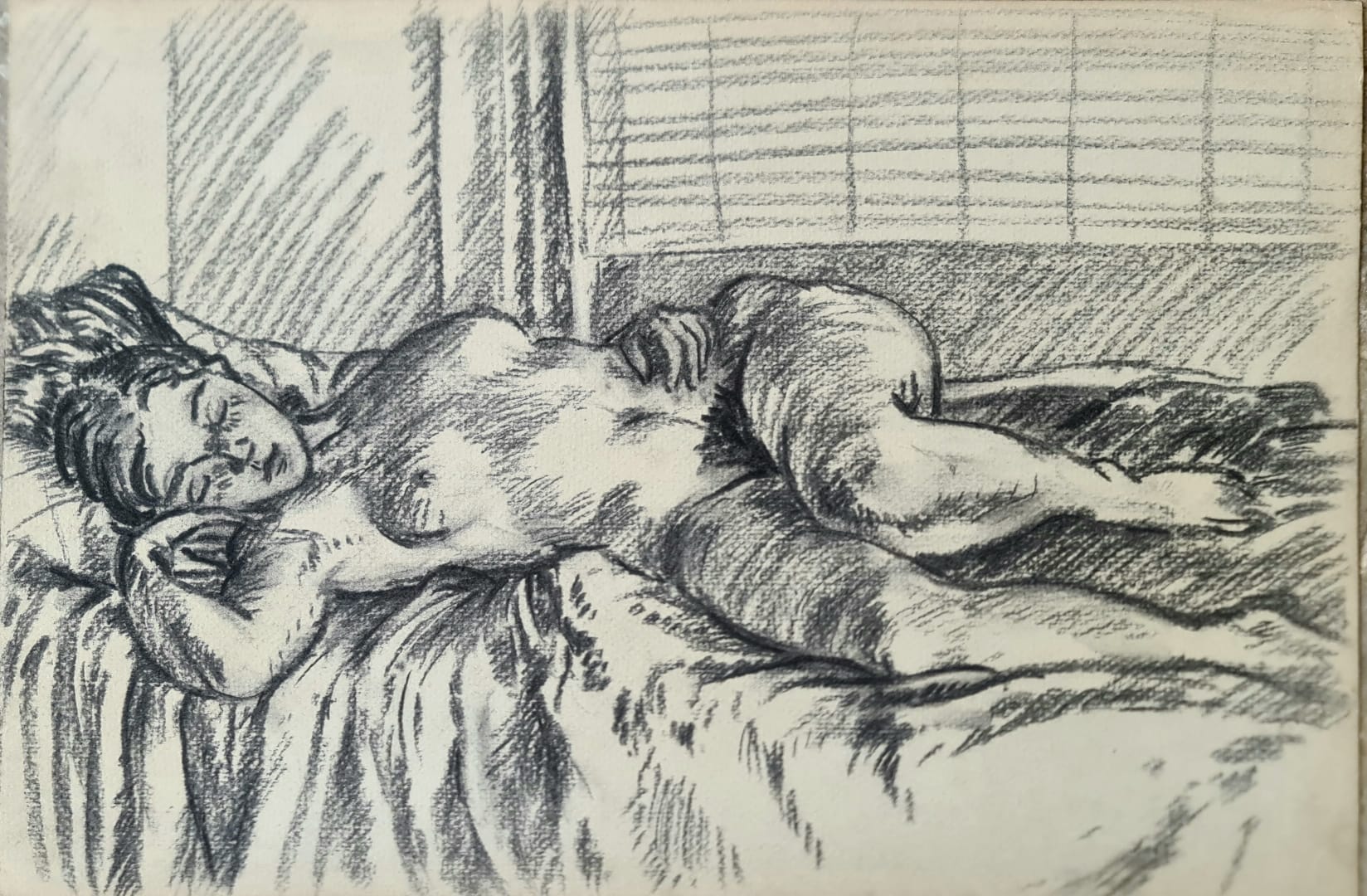
The subject should fill the page, but the subject must be correctly proportioned with respect to itself. Filling the page does not mean distorting the proportions of the subject such that the whole page is actually covered. It means making the correctly proportioned subject as large in the page as possible. Just as a standing figure is probably narrower with respect to its height than the rectangle of paper you are drawing it on, so a horizontal figure can probably fit into a narrower rectangle than the paper you are probably using. The space to left and right of a vertical figure will then probably be larger than the margin above and below, just as the space above and below a horizontal figure will be larger than the margins to left and right.
Filling the page means making the subject as large as possible, while respecting proportions.
Respecting the proportions of a subject means understanding the size relations between the various parts, and the position of each part relative to other parts. That understanding requires eye training. In the absence of teacher and classroom, the student must attend to their own eye training. A proper discussion of eye training requires a separate writing, but I will here offer a hint of how to proceed. If you are drawing a standing figure, since it must first of all fill the page, the head will be at the top and the feet will be at the bottom. But where does the rest of the figure go? Where, for example, is the belly button? A way to determine the position of the belly button might be to compare the distance from the belly button to the top of the head with the distance from the belly button to the bottom of the feet. If the two distances are exactly equal, the belly button will be exactly in the middle of the page. That distance, however, will probably not be equal. The difference between the two distances must then be understood, and that understanding will determine the proper position of the belly button. In such a manner the vertical position of the belly button can be determined. Depending on the pose, however, the belly button, or any other part, will also have a horizontal position. For example, it might be positioned to the right, to the left, or exactly above the foot that carries the model’s weight. Respecting the proportions of a subject requires measurements to determine the proper position of each part with respect to its horizontal and vertical relations to other parts.
Making such measurements must become second nature so that they happen instantly and automatically and higher considerations can occupy our attention. At first this may be laborious. However, it is a basic and always primary aspect of drawing. I often say that when I draw, I do nothing else but try to put things in their place.
2 - SHOW THE GROUND
The second rule is only possible to respect if the first is respected. For example, if a standing figure is cut off at the ankles the second rule cannot be followed.
The ground is whatever carries the subject’s weight. In the case of a model this is usually the floor. However, depending on the subject it might be a tabletop on which an object is sitting, a cushion on which a cat is sleeping and so on.
Showing the ground is the most basic first step to truly filling the page, for after we have made the subject as large as possible in the page there will still be empty space on either side of a vertical subject or above and below a horizontal subject. The subject is a delimited volume of some sort. But volumes, bodies or objects, are in space. Showing the ground is a first and fundamental way of indicating not only the space around a body, but the relation of that body to the space around it in which it moves. Without a feeling of weight or gravity, motion is mere ineffectual thrashing, and can only be represented as pure posture, like a space walker.
A simple convention for showing ground is to indicate a bit of shadow at the feet of a figure. That indication will define the floor or the ground. Even such a minimal and perfunctory indication begins to open up the space around the subject.
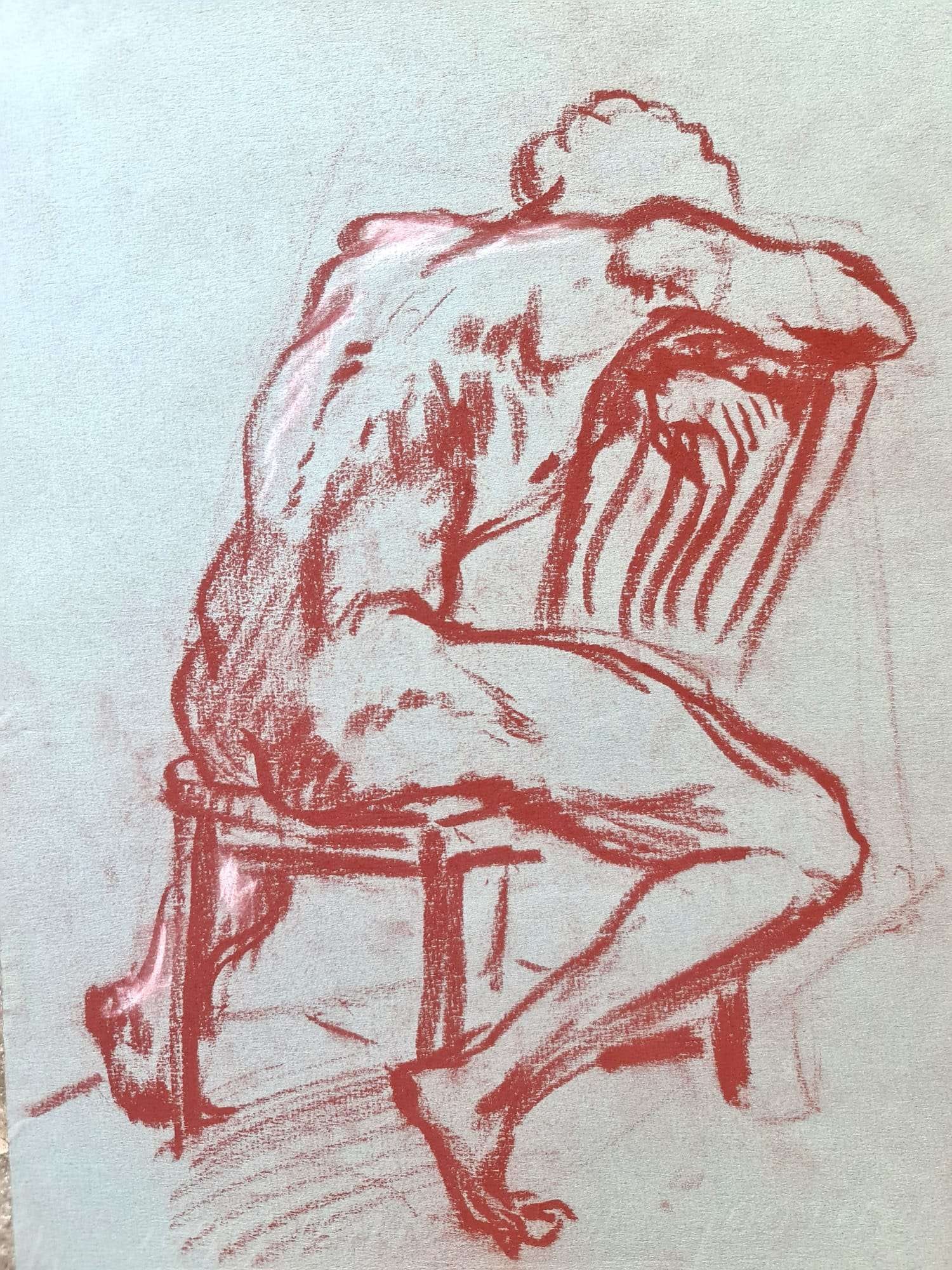
Because each mark is both decorative and illustrative, unless we are attentive to how we are filling the page both decoratively (lines on the surface) and illustratively (spatial illusion of near and far) we are not exploiting the potential of each mark. Always making indication of the ground a priority helps develop this crucial awareness of space not only as the volume of a body but also as the space around that body.
3 - EXPRESS THE CHARACTER OF THE SUBJECT
The third rule, or the third thing that must be striven for, may seem more related to something artistic or poetic, and to be therefore more important for art, but unless the principles embodied in the first two rules are respected, this third aspect cannot be fully realized.
When you draw you are doing more than filling a page, more than understanding and mapping the proportions of a subject. You are saying something about the subject. But what, apart from the usual vague talk that has no practical value, does “saying something” mean when it comes to drawing? Most fundamentally it means showing what is near and what is far. When you draw a head, unless you show that parts of it are near and other parts are far, you are not expressing its volume, its spherical character, because all volumes are volumes in space. They have parts that are near and parts that are far.
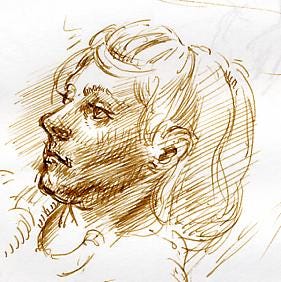
But capturing the character of a subject depends upon more than expressing nearness and farness; we must see and understand that character. When we identify or feel the character of a subject, we then can and should bring it out. To bring out means to emphasize, exaggerate or caricature. But caricature can be subtle or extreme. When extreme it becomes a cartoon. Cartoon style caricature is a lower art because it does one thing so much that other aspects are crowded out. But exaggerating to an extreme serves the end of being comic, and comedy is sometimes the goal: if a rear end is to be bitten, best that it protrude and that the jaws which will bite be open very wide.
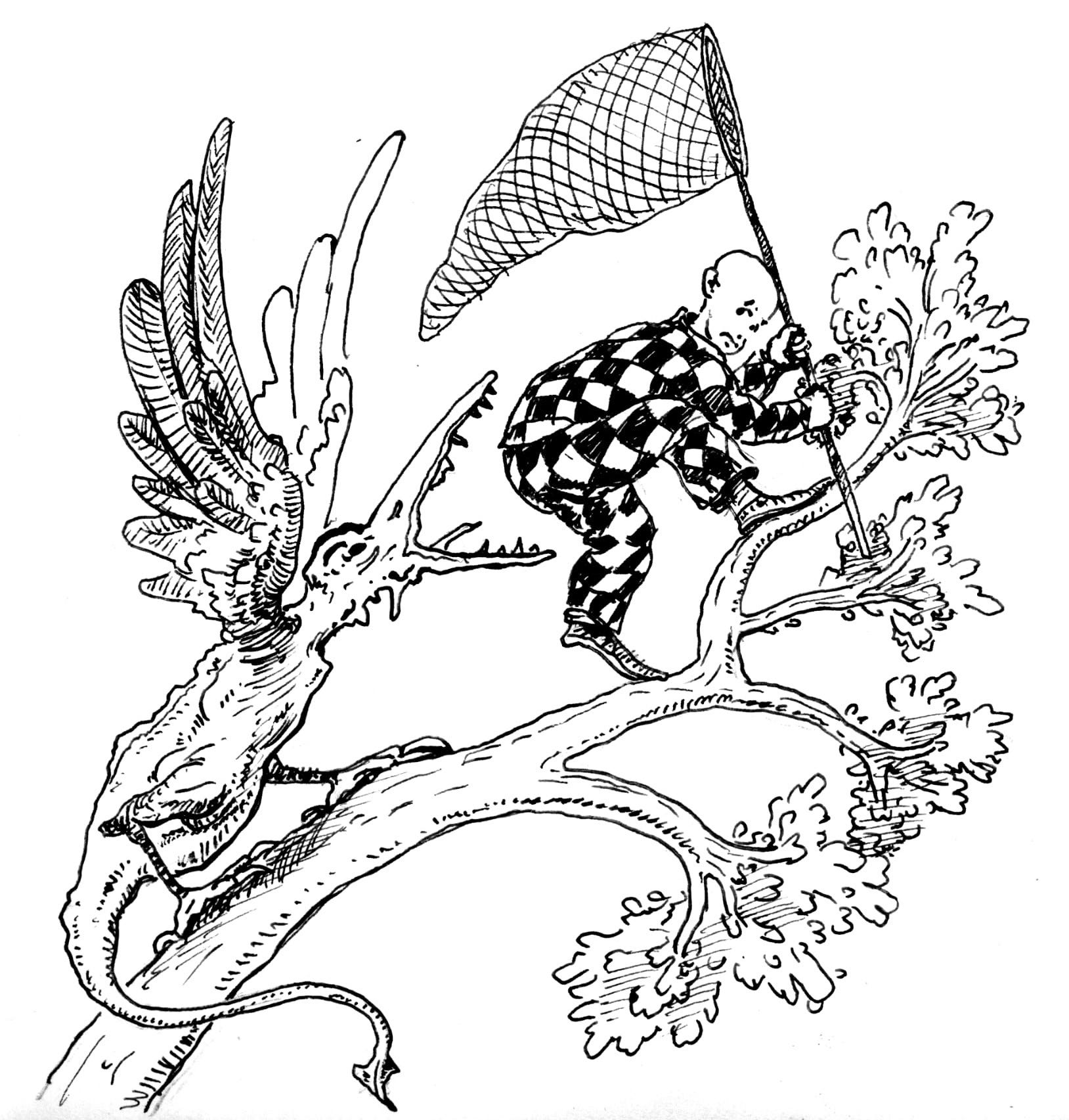
Today, with the prevalence of a scientific or soulless obsession with exactitude that is purely optical, drawing is often reduced to photographic “accuracy”. Such accuracy or exactitude, however, is a distortion of how we actually see. Photographs, or perspectively exact drawings often introduce obvious distortions, because human perception, even if we try to limit it to the optical aspect, is always more than purely optical. It includes our understanding of how things are in themselves. In other words our visual perceptions, as visual perceptions, are always nourished or augmented by our knowledge of how things actually are.
A photograph which accurately records the relative size of head and hand as actually perceived by the human eye, can strike us as seriously distorted.

Human optical perception begins exactly like a camera: it uses a lens to focus light on a perceptive surface. But human vision is not limited to the sort of raw data presented in photographs; first of all it is binocular, and then it is always in a situation of movement and change, and finally it is nourished by a lifetime of familiarity and practical relations with objects seen.
A true draftsman could, but never would, represent things as a camera does because that practically always contradicts what we know about what we see. What we know about the face and the hand is that they are approximately the same size. Even if, as in this photograph, the hand is an arm’s length farther away from us than the head, it should not be represented as so small or however much smaller it would appear at that distance, which appearance of course depends on how close the head is to our point of observation. This is because such optical distortion, which is a permanent fact of optics, and thus an aspect of our optical experience, is overwhelmingly contradicted by our actual experience of vision which, based on our knowledge of things, habitually adjusts how we “see”, or how we understand or live our visual experience.
With regard to perspective, if we observe a cube like shape from below, for example a building, the lines defining the upper plain of such a form will both slant downwards from their meeting point. The rules of perspective explain this appearance, and drawings which apply the rules of perspective strictly, like photographs, always demonstrate this optical fact.
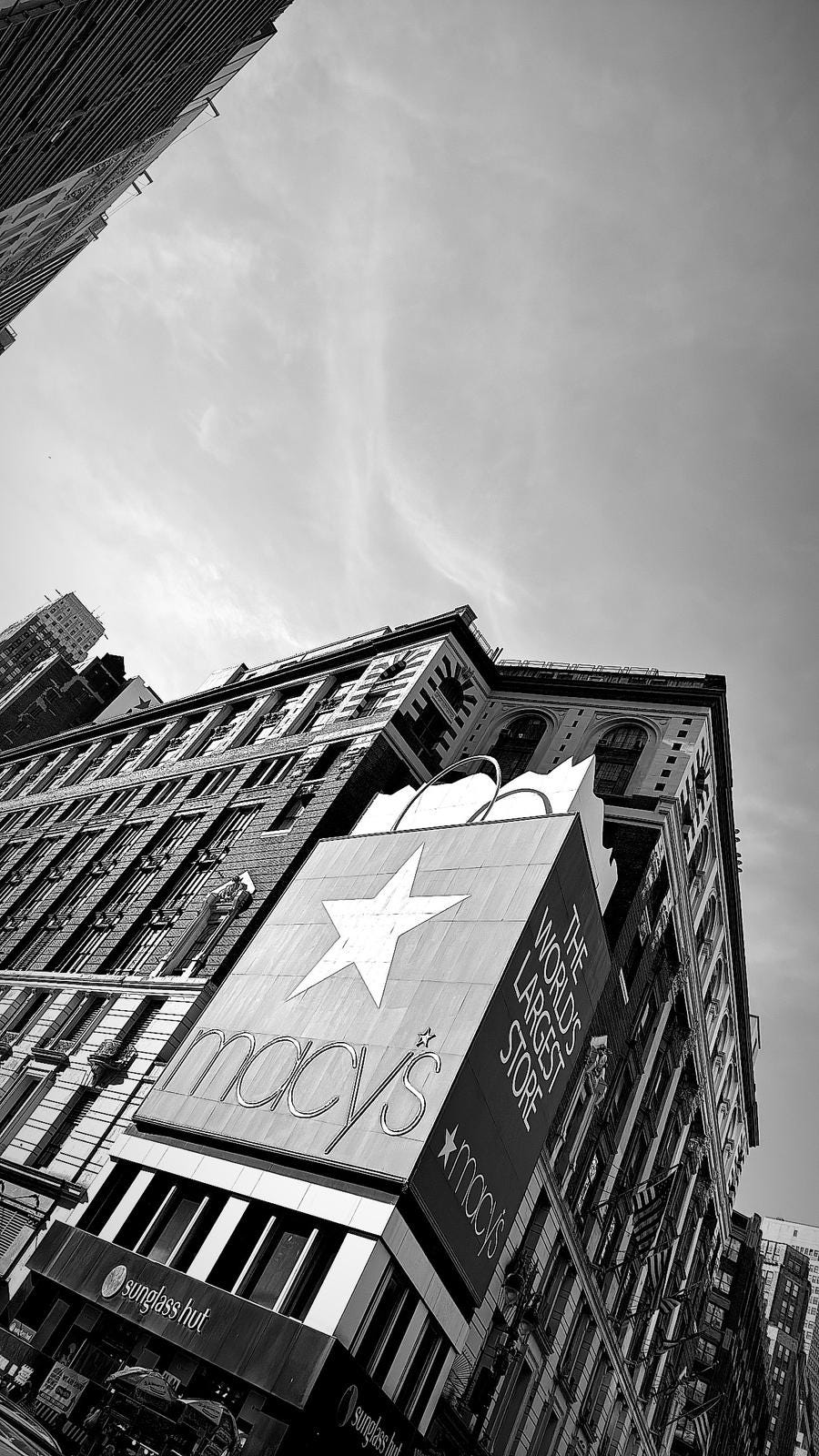
Competent draftsmen, however, use perspective with discretion so that optical reality does not unnecessarily and disturbingly contradict the reality of our visual experience. A clear example is how, when representing buildings, competent draftsmen usually represent the roof line of a wall facing us as horizontal. This breaks the rules of perspective, according to which that line should slant downwards from its point of junction with the receding wall. But it corresponds to what we know about buildings, namely that they are not constructed of crazy diagonals which change every time we observe them from a new perspective, but are stable and cubical in character.
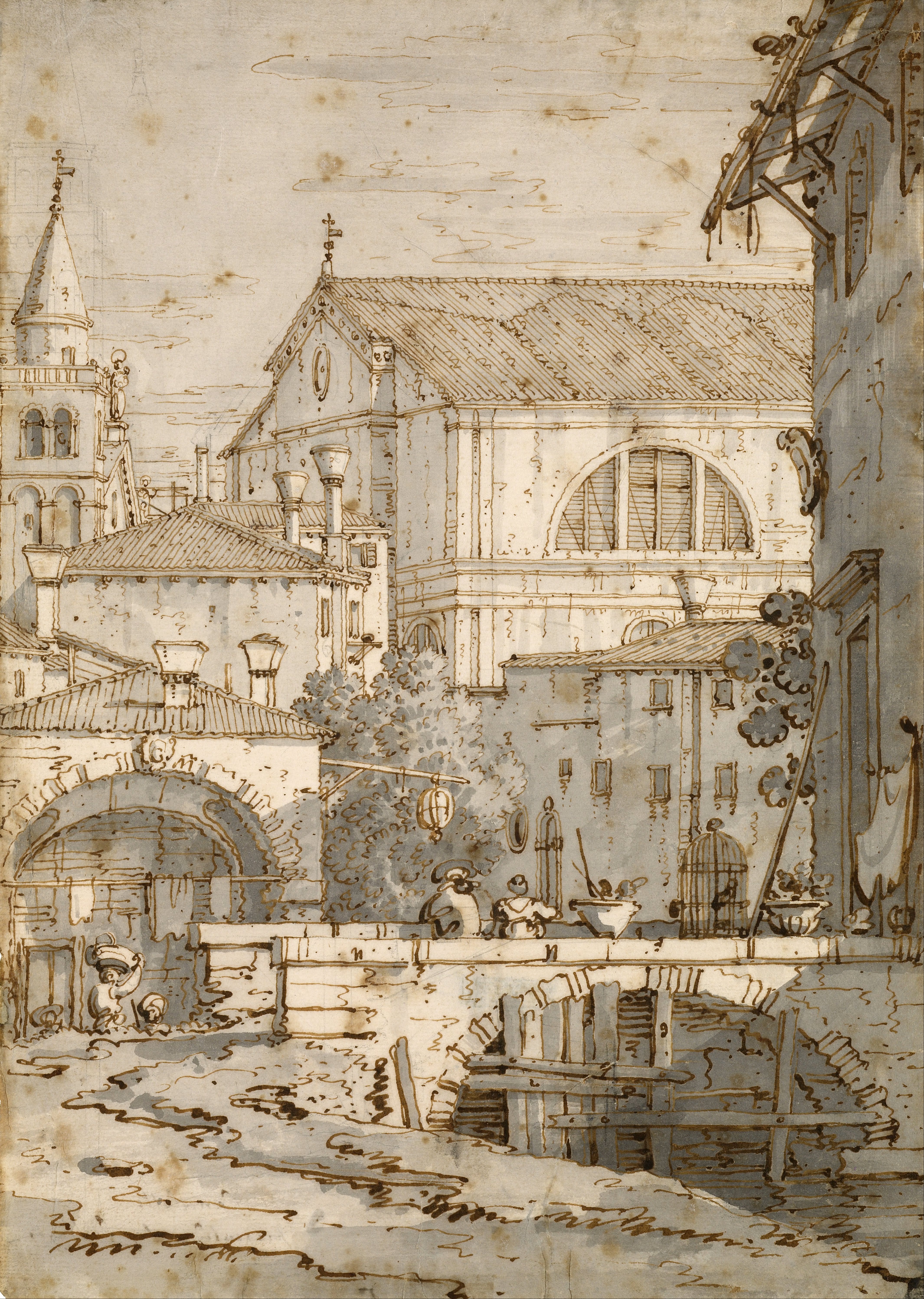
This is one kind of distortion which relates to expressing the character or truth of a thing. Another kind relates to motion or implied motion: the action of a figure should be emphasized in the direction or sense of the action. This principle is as true for figures in action as for those in repose, for repose is also a sort of action which will be implicit in the relations of the parts, and relations of parts is how any action is defined. If a figure is reaching out, if the relations that express that reaching (for example the angle and length of an arm) are not at least accurately transcribed in their quality of reaching, the expression of the action will be de-emphasized and diminished; for example, if the arm is made shorter than it actually appears. But if those relations are caricatured, underlined, exaggerated, brought out, or however we describe such emphasis, there will be no ambiguity concerning the action. If the action in question is central to the sense of the drawing such emphasis is all the more important.
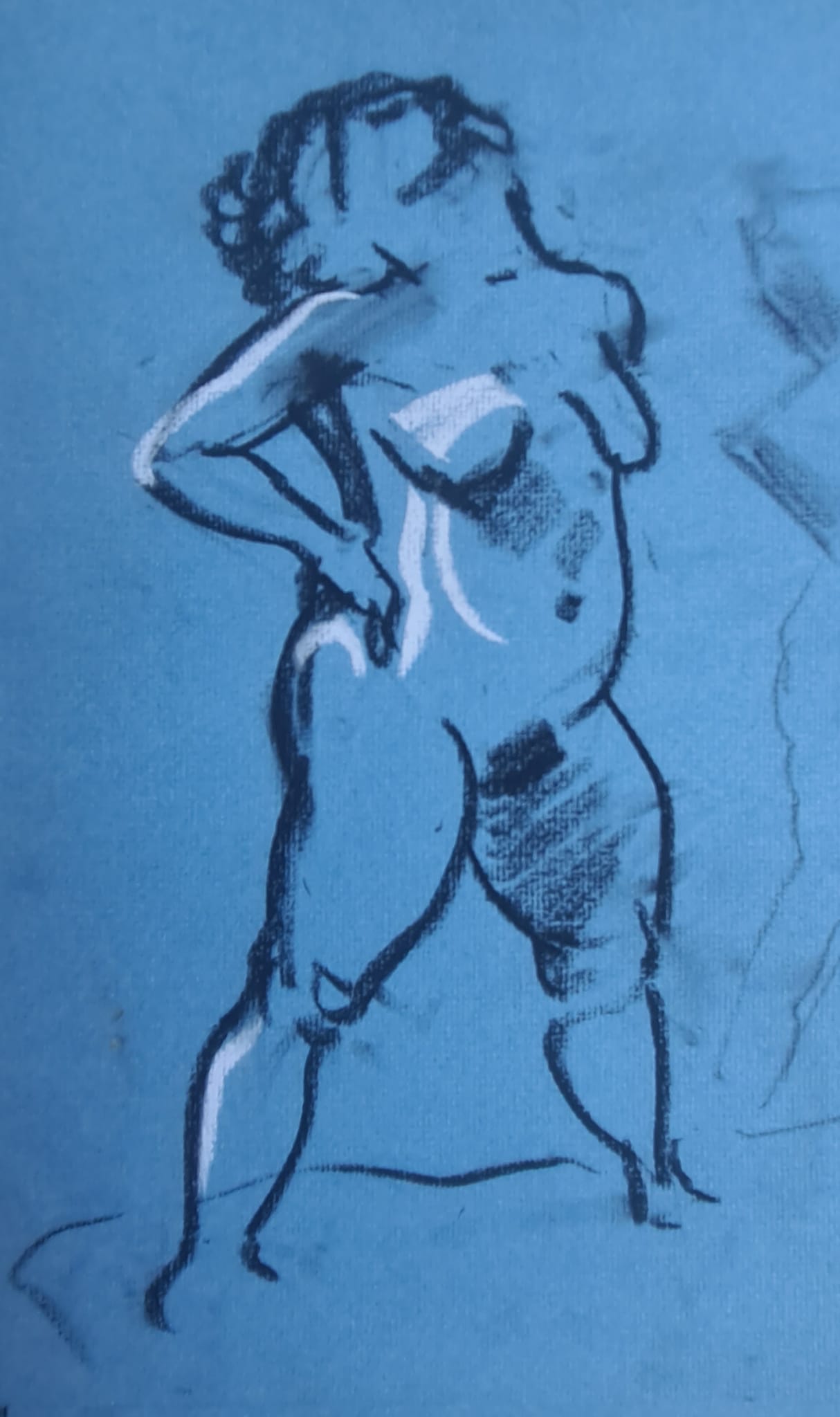
Yet another kind of distortion is what we usually think of when speaking of caricature. Caricature drawings, political cartoons for example, bring out the character of a person’s face and features by exaggerating the salient parts while respecting the relations between the parts. Caricatures, despite their often fantastical distortions, remain recognizable portraits because, not the actual sizes and shapes of the features but their relative sizes and shapes are respected even though exaggerated. Even when the exaggeration is outrageous, if these relations are respected, the “truth”, so to speak, of the caricature remains.
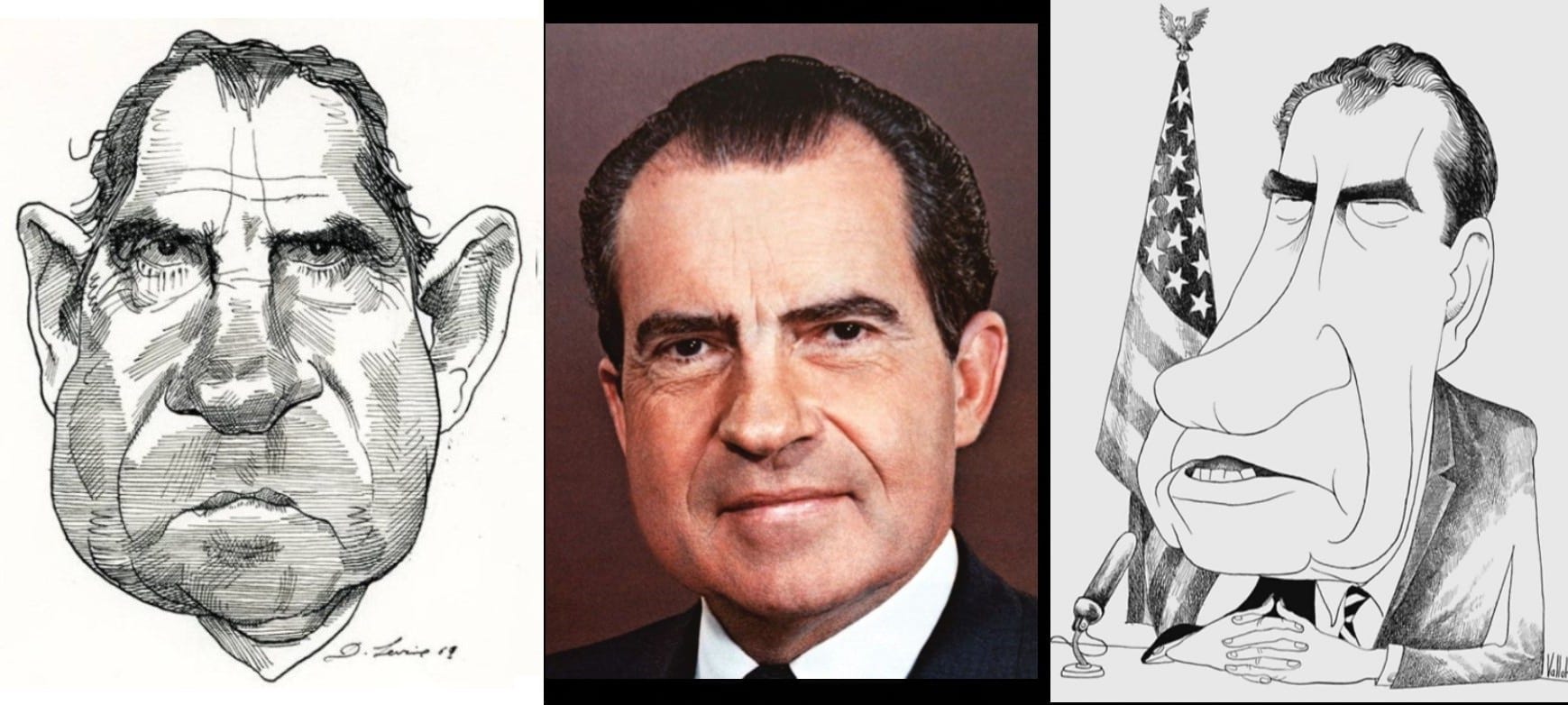
This strange fact, that what a draftsman naturally does is expressive and true, while images that are only optically accurate appear distorted and are inexpressive, has important implications for painting. Fundamentally, and while insisting on the expressive necessity of the representational aspect of painting, a drawing is not a transcription of an optical moment, but an expressive statement about a draftsman’s understanding of something. By “understand” I do not mean a logical or metaphysical explanation, but simply how, when we look at something, we see, feel and absorb a meaning in an immediate and experiential way. That understanding is the subject or that which is to be described on a page in volumetric and spatial terms.
How, very concretely, is this done? A full answer to the question goes beyond this writing, but I will offer a partial and preliminary answer which may serve as a further rule or guideline for this approach:
4 - USE SIMPLE LINES AND OVERLAPS
When you draw you are first of all making marks on a page. These marks will have spatial implications. But marks made on a page by a performing elephant or monkey will also have these two characteristics (decorating the surface of the page, and implying or illustrating volume and space). In other words marks, no matter how casually or unguidedly made, will to some extent do those two things. The draftsman, however, seeks to draw at a high level, to make marks which powerfully decorate the page and convincingly illustrate volume and space. Doing these things together in the right way is to “create a form”.
The first and most important step in this direction is filling the page with the subject, but the apprentice draftsman will want further guidance: how, he will ask, can I make my marks do these things powerfully? The first step to that end, to the making of marks that are powerful, effective or expressive, is to be deliberate. Each mark, each line, should be the fruit of a decision, a choice, made after calculation, measurement, consideration and thought. Such deliberation should be guided by the rules described above, namely to the ends of filling the page and expressing volume and space. But how, specifically, are marks made which express volume? The most fundamental way lines express volume is by overlaps.
A line implies many things. To begin with it implies the edge of a form, and thus a volume on one side and space on the other. It also implies a direction, or the prolongation of a form beyond what is actually marked. (See chapter 4 of ‘Art in the Age of Anxiety’, free online at paulrhoads.org). Then, when a line, or the implication of a line (which is its implied prolongation) encounters another line, it defines which side of that line defines form and which defines space.
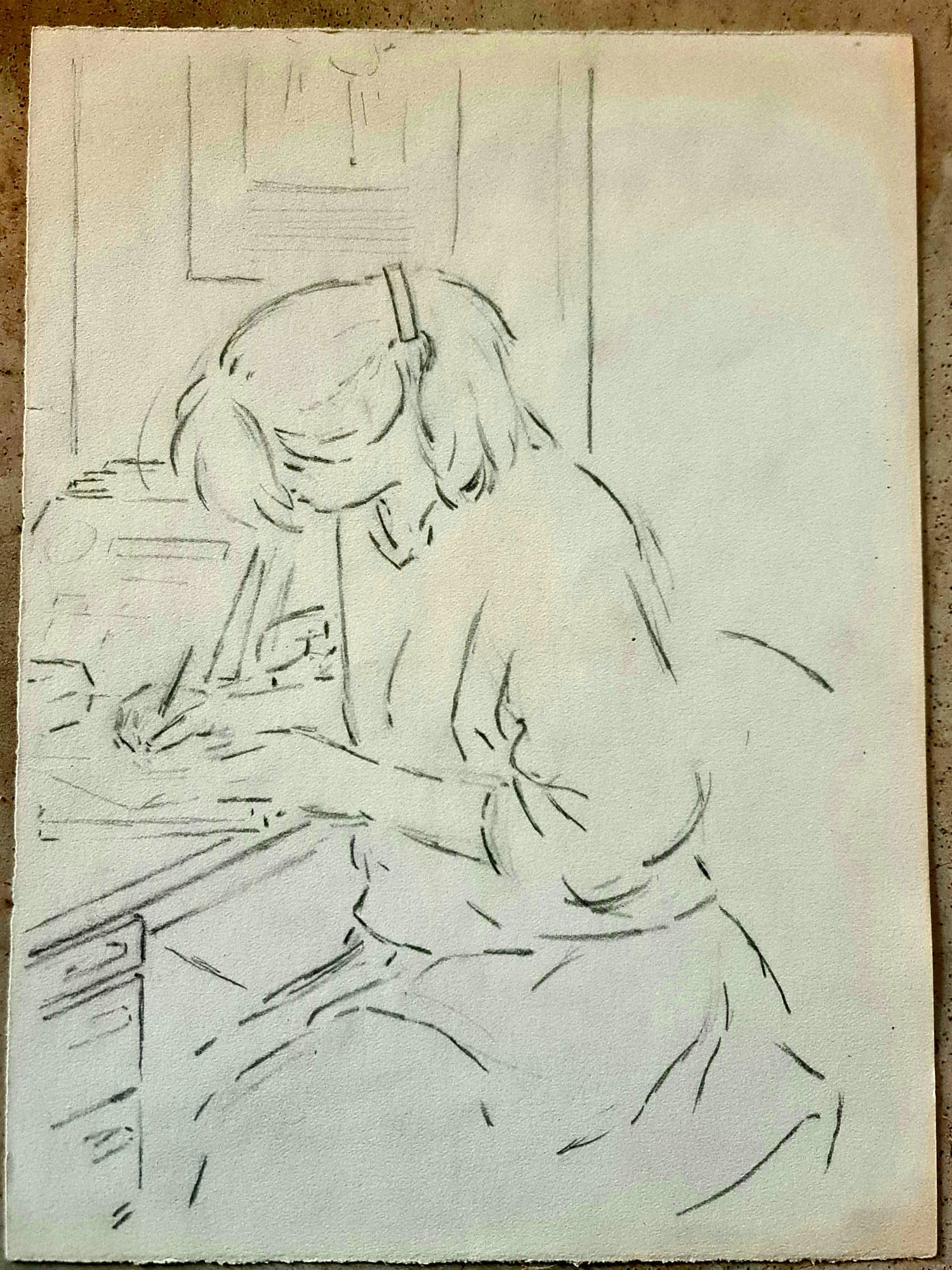
In this drawing the vertical line which defines the corner of the room, descends without actually touching the line which defines the shoulder, but the implication is absolutely clear: the descending line is part of a volume (the walls) which are well behind the volume of the shoulder. The area below and to the left of this shoulder line is, thereby, both the volume of the shoulder, and clearly nearer than the walls which are above and to the right. This drawing uses a manner of extremely clear and deliberate lines, often emphasizing overlaps by leaving blank space between lines. It is full of examples of overlaps, and the spatial dynamics of overlaps are clearly shown.
Here is another drawing done in a manner less starkly and rigidly deliberate, but fundamentally similar:
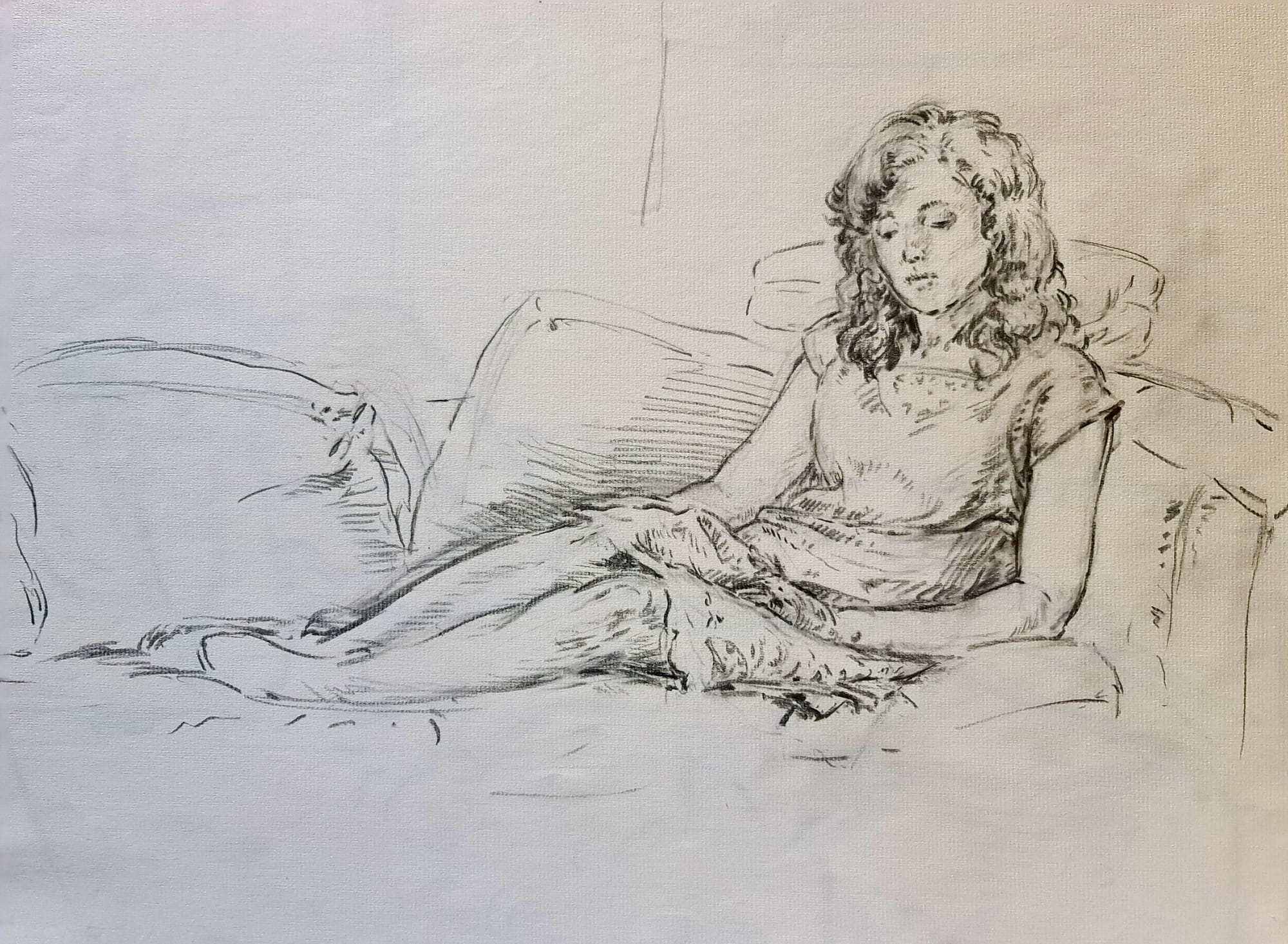
The overlapping may be less immediately obvious but it is equally and always present throughout. After examining these two drawings you will be able to recognize the important and even transcendent role of overlaps in almost all drawings by the old masters.
To begin to make overlaps the basic tool it ought to be for yourself, and in the context of this approach, oblige yourself to limit your manner of mark-making to clear and definite lines, in clear and definite relation to your other lines. To this end discipline yourself to draw lines only once. By this I do not mean that you must not correct your lines, but that you should not repeat them, or draw over them mindlessly with a nervous, unguided and undisciplined hand. After drawing a line, if it does not satisfy you (because it is not in the right place or not dark enough) do not trace over it again and again. Instead draw a better line in a better place. You can erase the line you don’t like before redrawing it, erasure, however, is not strictly necessary, because the best line will speak and the wrong line will disappear. Good lines are strong because they express the character of the subject, and an understanding of the character of the subject is, in an important sense, the substance or essence of a subject. Good or correct lines will make weak or wrong lines invisible, because what is expressive will be heard because it has something to say, and what is not will be ignored because it says nothing.
By struggling to apply the above rules or guidelines to your drawing, though at first it will probably be impossible to do so adequately or fully, you will be building the inner tools of draftsmanship which is the highroad to so many of the arts.